

Distance Learning and Learning Anxiety
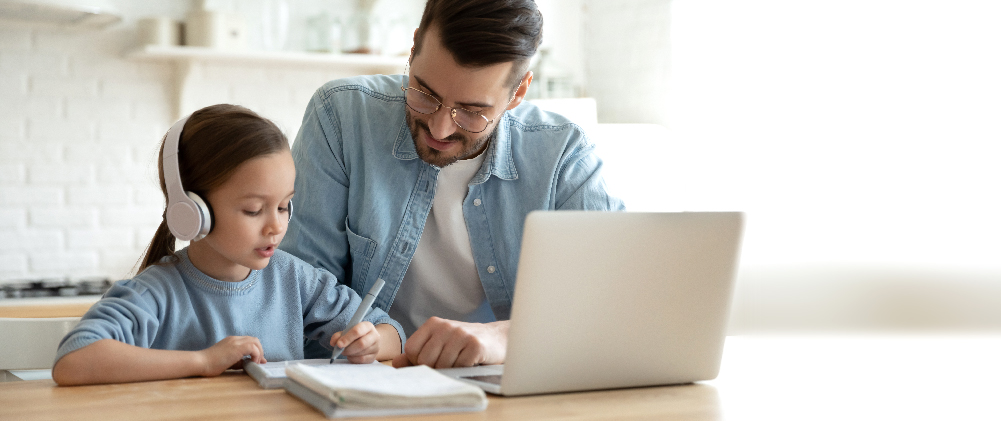
In a period where all the data changes in our children’s daily lives, without personal choice, mental tension increases and endurance is limited.
In all this, even the way children absorb information or communicate in their lesson is something completely new. The challenges of virtual learning are enough to make even the calmest children and parents have difficulty reacting to this condition.
Practical tips for parents to help their children:
Find your calm zone.
Try to do everything you can to stay calm when there is a crisis. It is natural for parents to get upset when their child is upset. However, if adults fail to remain calm for the child, the situation can worsen.
Staying calm does not mean remaining in a false perspective of events, only positively oriented and canceling out the difficulty.
Acknowledge and validate your child’s feelings in a calm voice, saying:
- “I know how annoying this is. We will get through this.”
- “It seems like you are feeling frustrated / angry / sad. Let’s see what I can do to help you.”
It is important for parents not to forget that this situation is not the child’s fault, nor did he choose it, nor has he been trained for it. Therefore, recognizing this effort is necessary so that no one gets frustrated.
In this difficult situation, parents, with their behavior, can only form good coping skills when they are frustrated, so that children can learn too.
Address the problem!
After you have calmly validated their feelings, address whatever caused the reaction. Talk about the problem and deal with it together. Talking about difficulties, whether practical or emotional, always helps.
Create a framework for honest sharing as a family, where it is acceptable for children to share any problem and address the issues one by one with various strategies or tools.
It is important that parents can listen to the child’s capabilities and what helps them with learning or concentration or anxiety, so that based on the above, they can build a series of help.
Plan proactively.
Think about ways to prevent future accidents in distance learning such as your child’s participation in the process. Planning can help children feel calmer and that they have things under control.
Consider these prevention strategies:
- Create a daily schedule with login information for each class.
- Set alarms for start times, breaks, or other important times.
- Keep a list of each teacher’s name and contact information.
- Prevention can help avoid some of the annoyances that put pressure and stress on the family system.
Understand that webcams can cause anxiety.
Does your child avoid virtual meetings or react differently when it’s time for class? Some children get anxious when they see themselves on a video call. This can affect their learning as well as their mental health. First, try to figure out what’s making them anxious.
Is their room in the background?
Set up the call in another room. Are they worried about their appearance? Help them wake up earlier so they have enough time to get dressed and get ready.
In some cases, parents can communicate with their child’s teachers about their child’s issues so that there is a comprehensive approach to the issue that arises and that one side supports the other.
At the same time, of course, it is necessary and paramount to communicate and share with the child first so that he has the opportunity to reflect his concerns through the conversation with you.
Avoid toxic positivity
Managing stress does not mean that you will have a false and toxic positivity, that is, pretend that everything is wonderful even if it is not. If you insist on the so-called toxic positivity, it will not allow you to express your disappointment, anger or sadness.
We don’t want to teach our children that we don’t have concerns or feelings. We need to acknowledge and label our feelings and express them in healthy ways.
In other words, we don’t have to pretend that the pandemic is an easy situation for us, and when we are authentic about how we really feel, that’s a relief.
The best thing to do is not to focus on the mistakes and to discuss with your child your difficulties and the new ways of coping that you are learning.
Don’t forget, however, that like any skill, you need to practice and what you create will become easier over time. The most important thing, ultimately, is that all the above skills that you will focus on and make your own, you will be able to use them in other areas of your life long after the pandemic is over.
Author