

WORRY SIGNS FOR YOUR CHILD’S SYMPTOMS
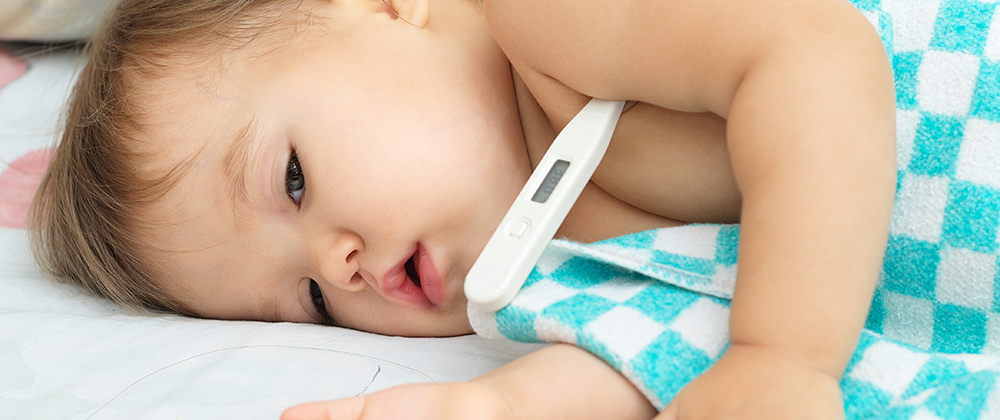
Fever is a non-specific sign that occurs in a wide range of diseases…
Especially during the winter season, parents know that their child gets sick easily, six or seven times a day with cough, fever, headache and runny nose being almost on the agenda. Although, however, the natural tendency of parents is to worry when they see their child getting sick, the truth is that there are rare cases when the symptoms may indicate something extremely serious or even life-threatening.
When the child loses his mood, is whining, is moody and does not feel like playing, he is really sick – and it is possible that this tendency constitutes a serious symptom of his illness, in which case the pediatrician should be informed.
The height of the fever is not a danger to the child, but we should know where it is coming from. Whether the child has 38°C or 40°C it is the same. However, if it is due to a microbe, it must be diagnosed immediately and antibiotics should be started, while if it is due to a virus and the child feels well, there is no need to worry, nor even to give an antipyretic.
The general rule for children and adults is that we administer antipyretics when the patient does not feel well and we need to relieve him.
Fever can be dangerous in children under one year of age, that is, in newborns and infants. These children, when they develop a fever (i.e. a temperature above 38°C), should be checked by their pediatrician immediately, within the first 24 hours.
A fever is defined as a temperature above 38°C.
Antipyretics should be administered if and as long as the patient is not feeling well.
Special monitoring of fever is needed if the child:
a) appears very ill and/or is unusually ill, sleepy or was in an unusually warm place (e.g. in an overheated car) before developing the fever.
b) He presents other accompanying symptoms such as stiff neck, severe headache, severe sore throat, severe ear pain, unexplained rash, recurrent vomiting or diarrhea.
c) He has a diagnosed immunodeficiency.
d) His fever persists for more than 24 hours, and he is under 2 years old, his fever persists for more than 72 hours and he is over 2 years old, he has a fever over 40 degrees (regardless of age).
Cough is a very common symptom, but parents should be concerned if the child has a “boil”, hoarseness of the voice or his cough is prolonged and shows difficulty breathing.
Hoarseness occurs when the larynx becomes swollen and begins to narrow. Hoarseness can be especially dangerous in children under 3 years of age, because their larynx is narrow and there is a risk of it closing completely, making it difficult for them to breathe. Therefore, if the child is young and develops hoarseness, parents should contact their pediatrician immediately.
In abdominal pain the general rule is that when the pain appears, subsides and starts again, there is no particular reason for concern. However, when the pain is localized, continuous and increasing in intensity, there is reason for concern. Of course, it is of great importance if it is accompanied by other symptoms, such as vomiting, diarrhea or rash, but, in any case, parents should contact their pediatrician.
A headache needs to be checked if:
a) It lasts for several hours or is so severe that the child interrupts his activities.
b) It is strong and sudden or is accompanied by fever, vomiting, confusion or stiffness of the
neck.
c) It occurs very frequently.
A rash needs to be checked if:
a) It manifests itself with red pimples that do not discolor with pressure.
b) It is extensive or causes pain to the child or the child looks sick.
c) It covers a large area, looks like a burn, without the child having been burned.
Diarrhea and vomiting need to be checked if:
a) The child looks quite exhausted or shows signs of dehydration.
b) Hematemesis or blood in the stool occurs.
c) He has severe abdominal pain that does not subside with vomiting or there is a possibility of poisoning.
d) He has pain in the lower right abdomen and prefers to lie down and “fold”
e) He vomits repeatedly (>7-8) or he is under 12 weeks old and has a fever.
Author