

Unicompartmental knee arthroplasty: An advanced technique for a quick return to our daily lives
Knee pain caused by osteoarthritis seriously affects the movement of the joint and, by extension, the patient’s quality of life.
Knee osteoarthritis is the most common type of osteoarthritis of the lower limb.
It is estimated that 6% of people aged 30-40 and 15.2% of people aged 40-50 will suffer from this condition with a probability of 47% of developing knee arthritis at some point in their lives (lifetime risk) for everyone over 50 years of age.
In the majority of patients with knee osteoarthritis, the pathology is limited to the medial compartment of the knee (approximately 50%).
The knee has three compartments:
- the medial
- the lateral and
- the anterior
In practice, osteoarthritis can affect any of the three compartments of the knee. If osteoarthritis is limited to only one of these three compartments, we can choose unicompartmental arthroplasty as a technique.
How is the operation performed?
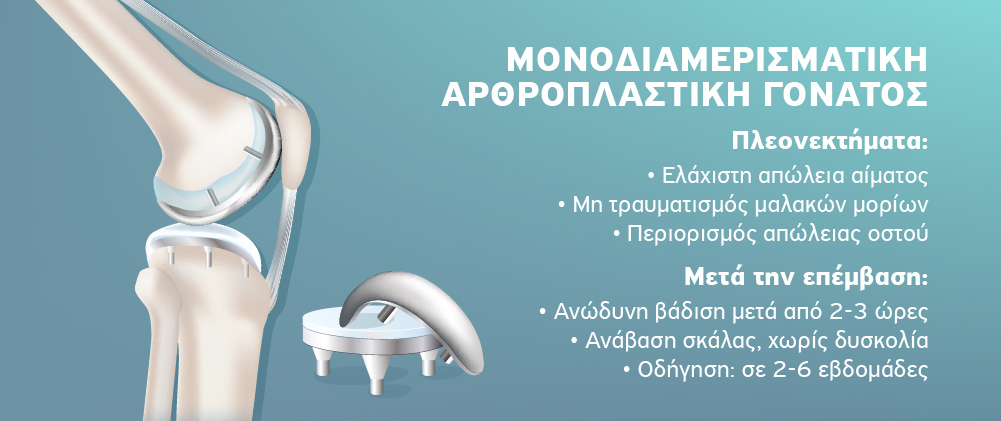
In this operation, only the part of the knee that suffers from arthritis is replaced, while the rest of the knee remains intact.
This means that injury to the soft tissues of the joint is limited to a minimum, resulting in the elimination of arthritic pain, improved knee functionality and a very short recovery time.
Due to the above, this operation is very well accepted and tolerated by the patient and significantly reduces the recovery time.
In particular, Unicompartmental Knee Arthroplasty (UNKA) is an established treatment option for knees suffering from arthritis in only one part of them and consists of three parts.
The femoral part, which is made of metal, a metal base that is placed on the tibia and between them there is a plastic, moving part (polyethylene).
What is the surgical technique?
Through a small incision on the front surface of the knee, the joint is exposed.
The surgeon will remove part of the meniscus that is damaged and the parts of the joint that are affected will be covered with two small prostheses, one on the femur and one on the tibia.
The plastic component located between these two metal prostheses is movable and replaces the damaged meniscus that was removed.
The metal materials can be placed in the bone with or without the use of cement, depending on the case.
After the correct placement of the materials, the surgeon performs an intraoperative clinical examination to ensure that there is a normal range of motion with good functionality, and then the joint capsule and skin are sutured with absorbable sutures and intradermal sutures, respectively.
What are the results of this specific operation?
MAG has extremely good results in twenty-year studies.
Factors such as age, body weight, and the patient’s activities play a very important role in the survival of the material as well as the patient’s postoperative course.
The patient is not transfused because blood loss during surgery is minimal, soft tissues are not injured and bone loss is greatly reduced.
Furthermore, the surgical incision is half the length of that of total arthroplasty.
After the operation, the patient can walk painlessly and immediately after a few hours (2-3), perform daily activities and use stairs without difficulty.
He can return to driving after two to six weeks and participate in sports activities such as swimming, tennis, golf and skiing after six to twelve weeks.
What are the advantages compared to total knee arthroplasty?
Total knee arthroplasty can offer significant benefits in quality of life for patients with end-stage osteoarthritis of the knee.
However, only 75% of patients are satisfied with the result regardless of the technique and design of the prosthesis used.
Since the basic requirement for unicompartmental knee arthroplasty is the preservation of the anterior cruciate ligament and the fact that the two remaining compartments of the knee remain in good condition, then one can expect a better range of motion and a more normal gait because the biomechanics of the knee are restored as close to normal as possible.
The result of a successful TKA compared to a total knee arthroplasty is, as one would expect, a feeling of a more normal knee, better joint kinematics and better immediate functional results.
Unicompartmental Knee Arthroplasty procedures require specialization, modern hospital logistical equipment and collaboration between medical specialties, which make up the Interdisciplinary Team.
The daily update on scientific developments combined with the continuous investments of the Athens Medical Group in biomedical equipment, allows us to provide the Group’s hospitals with the latest in modern technology so that we are able to offer the most personalized, safe and minimally invasive solution, for each case, no matter how complex it may be.
Author