

Sunburn and Heatstroke
The term sunstroke should be contrasted with the term heat stroke.
As clinical conditions, they have similarities, but also fundamental differences.
The common denominator is our thermoregulatory center, which is located in a specific area of the hypothalamus of the brain and functions exactly like a thermostat.
Under normal conditions, it is regulated at 37°C.
Specifically, in febrile diseases, pyrogenic substances are produced, which shift the thermostat to a higher point, e.g. 39°C.
However, this ensures that the body temperature is controlled and that it will not exceed the point set by the thermostat.
For this reason, fever does not cause brain damage.
On the contrary, in the event of a prolonged stay of the individual in a free environment of high temperature and humidity, much more combined with heavy muscular work or even sports, the body temperature rises uncontrollably (hyperthermia), because the thermostat continues and remains at 37°C, as there was no previous febrile illness to shift it to a higher point.
For this reason, the core body temperature even exceeds the limit of 40°C and irreparable damage is created in the brain and other organs and systems of the body.
SUNSHOT
As the term itself implies, this is a pathological condition, related to prolonged direct exposure to the sun, especially during the hours of maximum radiation (noon).
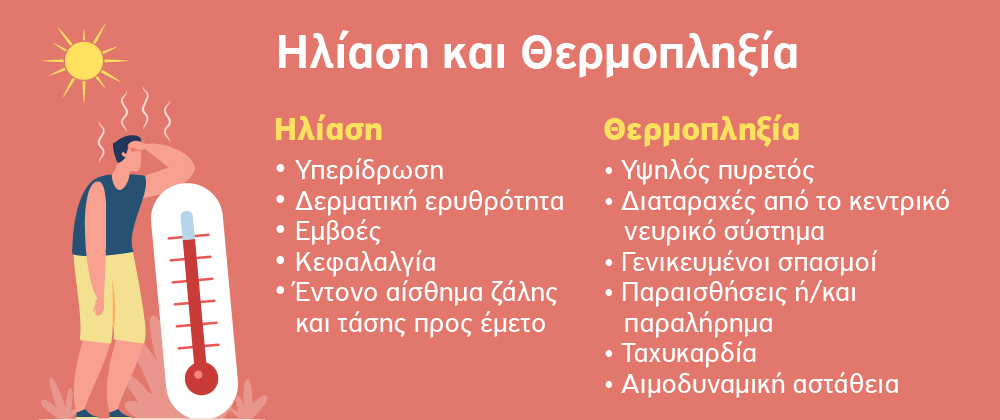
Symptoms are mainly due to loss of water and electrolytes and include red and hot skin, tachycardia, headache, nausea, vomiting, dizziness, hallucinations and in severe cases fever (39°C), convulsions and loss of consciousness.
From a therapeutic point of view, the patient is placed in a cool, shady place, with free air circulation, given fractional abundant fluids, except for coffee and alcohol, clothes are removed and the patient is doused with water and cold compresses.
Prevention includes avoiding direct exposure to the sun during midday hours, wearing a hat, frequent application of sunscreen with a high protection factor, abundant consumption of water and fruit juices and small, frequent meals, without fat.
It is strongly emphasized that newborns and infants should not be exposed directly to the sun, even if they are wearing a hat.
In older infants and toddlers, sun exposure is limited (30’- 60’) and always with a wide-brimmed hat and frequent application of cream with a high protection factor. In general, children have no reason to be exposed to the sun, even at sea, during the hours of maximum radiation.
It is recalled that sunburns, even 1st degree, in childhood have been implicated in melanoma in older ages.
HEAT STROKE
It is a serious and life-threatening condition.
The core body temperature exceeds 40°C. It is distinguished in classic heat stroke at rest and in this one due to exercise.
The first essentially concerns people who are of extreme ages, are not acclimatized, or suffer from chronic diseases and are on medication.
The 2nd affects, mainly, young people exercising or working outdoors, in extreme environmental temperatures.
The early symptoms of heatstroke are similar to those of heatstroke. Late symptoms include serious manifestations of the brain, kidneys, blood, myocardium, lungs and skin.
Treatment must be immediate and in less than 2 hours, otherwise the brain damage is permanent. It is noted that efforts include immediate reduction of temperature, according to the heatstroke and timely transport to the Hospital.



