

Athens Medical Center: First endovascular repair of an aortic aneurysm without an iodinated contrast agent
Athens, May 13, 2019 – For the first time in Greece, a percutaneous endovascular repair of an abdominal aortic aneurysm was successfully performed at the Athens Medical Center, using only carbon dioxide (CO2)—with no iodinated contrast agent whatsoever. This innovative new technique was applied by the vascular surgery team led by Dr. Theodosios Bisdas, MD, PhD—Associate Professor of Vascular Surgery at the University Hospital of Münster (Germany), and an Endovascular Surgeon and Phlebologist at the Clinic for Vascular and Endovascular Surgery.
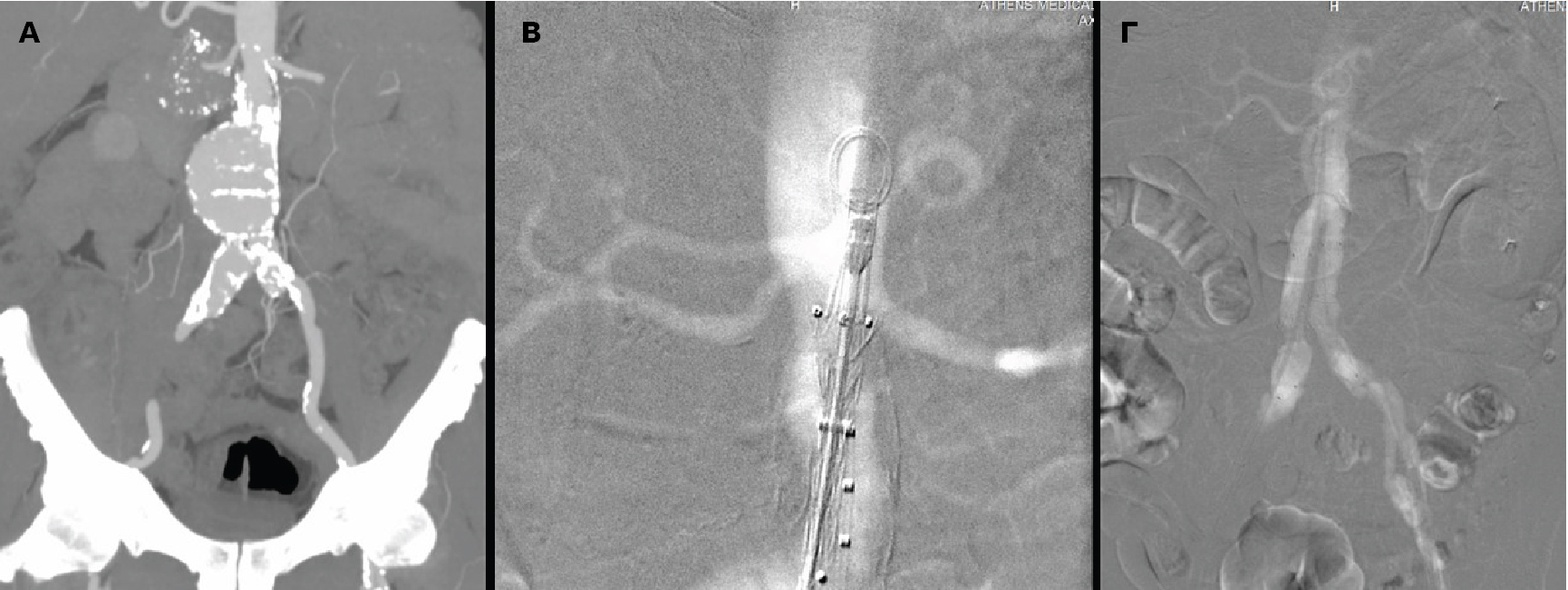 |
| A. Preoperative CT angiography of the abdominal aortic aneurysm; B. Intraoperative angiography using carbon dioxide for the precise deployment of the graft below the renal arteries; C. Final intraoperative carbon dioxide (CO2) angiography, confirming the successful endovascular repair of the aneurysm.
Endovascular treatment of aortic aneurysms has almost entirely replaced open surgery, due to the minimally invasive nature of the procedure, the patient’s rapid recovery, and the safety of modern endografts. However, this technique requires the use of an iodinated contrast agent—as part of the angiographic process—to visualize the blood vessels both before and after the placement of the endografts. The amount of contrast agent used is proportional to the complexity of the aneurysm. Furthermore, patients receive additional iodinated contrast during the CT angiography (CTA) scans that are required both preoperatively and postoperatively, particularly in cases of complex aortic aneurysms. Iodinated contrast agents are associated with the development of acute kidney injury, especially in patients with pre-existing renal impairment. Various studies have demonstrated a direct correlation between the volume of iodinated contrast administered and the risk of developing renal injury. This complication occurs in 15% of patients with renal impairment. Although the injury is self-limiting in most cases—resolving after approximately one week—a subset of patients (ranging from 0.5% to 12%) develops more severe damage or complete renal failure, conditions associated with high mortality rates and the potential need for temporary or permanent dialysis. In contrast, the specific method now being applied—**for the first time in Greece, at the Athens Medical Center**—is suitable for patients with renal impairment as well as those with an iodine allergy. It offers the unique capability of performing angiography using carbon dioxide (CO2), a medium that is both safe and kidney-friendly. It is worth noting that the quality of the angiography was comparable to that achieved with iodine-based contrast agents; the grafts were placed with complete success, effectively excluding the aneurysm; and the renal function of the patient with kidney disease remained entirely unaffected. This technique complements the already successful use of CO2 as a contrast agent in patients with peripheral vascular disease—a procedure performed by Dr. Theodosios Bisdas and his vascular surgery team. Following the procedure, Dr. Theodosios Bisdas stated: “Today’s operation represents a major success for Greek endovascular surgery and our team, as well as another ‘first’ in Greece for the Athens Medical Center. We are now able to offer patients with complex aortic aneurysms and compromised renal function an alternative imaging method—utilizing carbon dioxide (CO2)—that ensures both exceptional quality and safety. For my part, I would like to thank the Group’s management and its President, Dr. George Apostolopoulos, for their ongoing investment in cutting-edge medical equipment, which enhances the safety of our procedures.” For further media inquiries: Savvas Karagiannis, Communications Manager, General Directorate of Business Development, Athens Medical Group Tel.: 210 6287236, E-mail: s.karagiannis@iatriko.gr Health in your hands
Follow the Group Share the experience
Follow the Athens Medical Group on Social Media. Stay tuned and get reliable information on important health issues. 


|