

INNOVATIVE TECHNIQUES FOR THE REPAIR OF CONGENITAL THORACIC ANOMALIES AT THE IATRIKO DIABALKANIKO
The Interbalkan Medical Center in Thessaloniki is a pioneer in the treatment of congenital chest wall deformities, serving both Greece and Southeast Europe. It employs a globally innovative technique for the immediate correction of pectus carinatum (protruding sternum), as well as a technique for the correction of pectus excavatum (sunken sternum)—the only one of its kind available in Northern Greece.
This represents a significant scientific advancement within the highly specialized services offered by the Interbalkan Medical Center. It was achieved through a collaboration between pediatric surgeon Panagiotis Avtzoglou, the distinguished pediatric surgeon Avraam Mastorakis—Director of the Pediatric Surgery Clinic at the “Schwarzwald-Baar” teaching hospital in Germany—and his colleague, pediatric surgeon Sideris Chatzisideris, making it possible for these procedures to now be performed in Greece as well. 
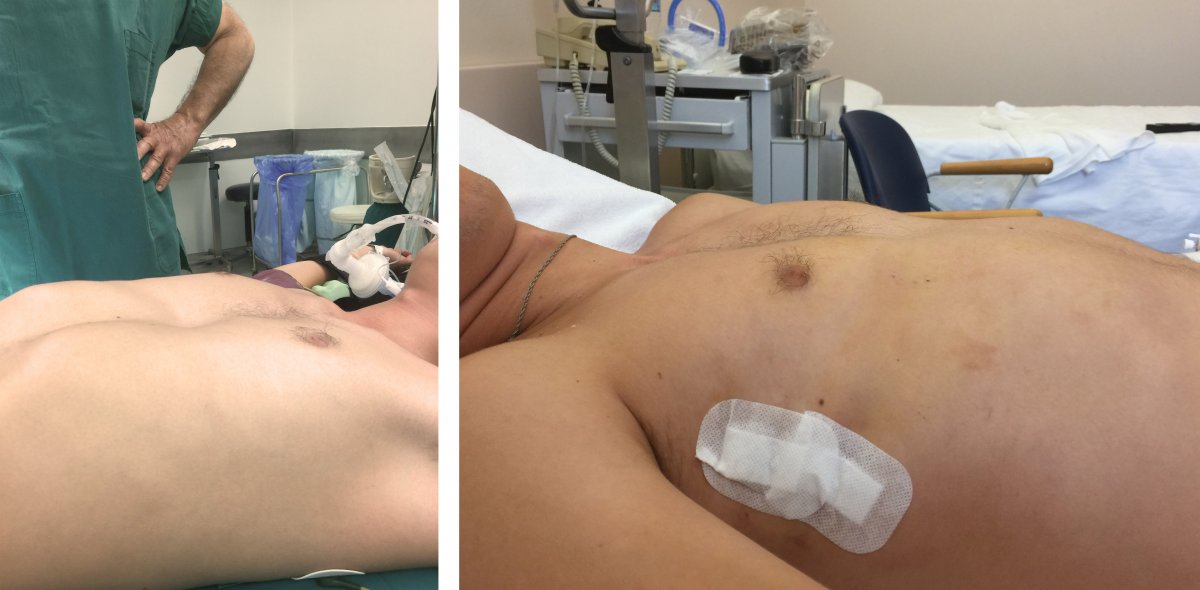
The first case involves a 16-year-old patient with a sunken chest (pectus excavatum) who underwent surgery; the procedure was a complete success, resulting in the full restoration of the chest wall and requiring a hospital stay of only 5 days.
“These are minimally invasive techniques that were first developed in the USA and subsequently introduced to Europe due to their impressive outcomes. We have been applying and refining them in Germany for years,” notes pediatric surgeon Avram Mastorakis, who further explains: “The procedures are primarily performed during adolescence, though they can also be carried out at younger ages—when deemed necessary—as well as in adults, with absolutely no issues. Based on my experience as an instructor for these specific techniques, I can attest that the patient goes to sleep with the problem and wakes up without it. These methods are effective, bloodless, completely safe, and—in experienced hands—free of complications.” The Conditions
“Pectus excavatum (sunken chest) causes an inward depression of the sternum and a reduction in the capacity of the thoracic cage. This limits the space available for the expansion of the lungs and heart, leads to scoliosis of the thoracic spine, and creates an aesthetic concern that can be distressing for children and adolescents,” explains pediatric surgeon Panagiotis Avtzoglou. He adds: “Pectus carinatum (a ‘bird-like’ or protruding sternum) is less common and primarily results in scoliosis and a significant aesthetic issue. Today, both conditions can be treated using minimally invasive techniques, yielding excellent results. Innovation and progress have become synonymous with the operations at the Medical Interbalkan Center. We are moving beyond the past and charting a new future in the treatment of congenital sternal deformities.”
Innovative Surgical Techniques
Dr. Mastorakis explains the two surgical techniques:
“For pectus excavatum, the condition is treated thoracoscopically using the ‘Nuss procedure—modified by the Mastorakis method’.” A bar made of medical-grade steel or titanium is placed within the patient’s chest, lifting the sternum and immediately expanding the thoracic cage. This results in improved lung and heart function, while addressing shortness of breath and other issues caused by reduced thoracic capacity. The surgery lasts 30–40 minutes, and the average hospital stay is 5 days. Shortly thereafter, the patient can return to educational activities, and within a few weeks, to sports—all without any complications. In the hands of an experienced, highly specialized surgical team, the risk of postoperative complications is virtually negligible.
This method replaces older surgical techniques, which were far more invasive, required longer hospital stays and recovery periods, and offered questionable efficacy. Consequently, many individuals affected by this condition previously opted against surgical intervention. The bar is removed after two years via a procedure requiring a one-day hospital stay; furthermore, its presence does not interfere with any future diagnostic tests the patient may undergo. “Regarding **pectus carinatum** (pigeon chest), my team is a global leader in the minimally invasive ‘Abramson – modified Mastorakis’ method. This approach involves the subcutaneous placement of a metal bar over the sternum, with specialized fixation to the rib cage. The technique has proven entirely successful, with zero complications, throughout the years we have employed it—both in Germany and, now, here in our home country. Aside from the duration of the procedure—which is approximately one hour—the same considerations apply as those for *pectus excavatum* (sunken chest),” concludes Dr. **Avraam Mastorakis.**
“Through pioneering and innovative methods, and with the support of colleagues”leading Greek physicians – many of whom excel abroad – and state-of-the-art equipment, we are bringing to life the vision of the Chairman of Athens Medical Group, G. Apostolopoulos, to establish Thessaloniki as an international healthcare center and a major medical tourism destination,” notes the General Manager of the Interbalkan Medical Center and Chief Operating Officer of Athens Medical Group, Vasileios Bardis, MSc HSM, DLSHTM.
Photos
- The medical team (from right): Pan. Avtzoglou, Avram Mastorakis, Sid. Chatzisideris
- Patient’s pectus excavatum before and after the minimally invasive procedure
Press Office
Tel: 2310 400904
REQUEST FOR PUBLICATION / TELEVISION AND RADIO BROADCAST / ONLINE POSTING


