

Electrophysiological study of the heart WITHOUT radiation at Medical Transbalkanikos
For the first time at the **Interbalkan Medical Center of Thessaloniki**, an electrophysiological study was performed on the heart of a 10-year-old child—**without any radiation exposure.**
This represents a highly significant method for cardiac assessment—particularly for **children and pregnant women**—made possible by a state-of-the-art electroanatomical mapping system recently acquired by the Interbalkan Medical Center’s **Electrophysiology Laboratory**. The system functions much like a GPS, operating without the use of hazardous ionizing radiation.
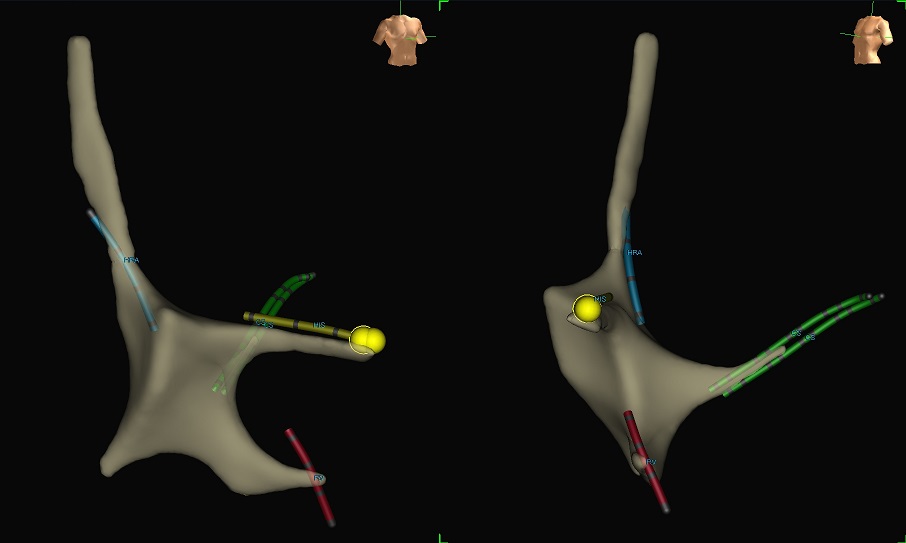
The hospital’s Electrophysiology Laboratory is now equipped to perform not only **diagnostic electrophysiological studies** but also **ablation procedures for supraventricular or atrial tachycardia**—all without any radiation exposure. Using a new electroanatomical mapping system, pediatric arrhythmologist Adrianos Kontogeorgis (MBBCh, MRCP, PhD) and the Director of the Electrophysiology Department, arrhythmologist Lilian Mantziari (MD, MSc, PhD), placed four electrodes inside the heart of a 10-year-old child—without the use of any radiation.
The system provided a 3D visualization of the electrodes’ positions, as well as other critical anatomical landmarks—such as the Bundle of His (part of the atrioventricular conduction system)—enabling a comprehensive examination.
In a conventional electrophysiological study—performed in laboratories lacking such advanced equipment—electrodes (leads) are placed at specific locations within the heart. These electrodes record local electrical activity and can also be used to stimulate the heart muscle via an external computer system.
Typically, the placement of these electrodes requires fluoroscopy (radiation), allowing the physician to guide and position them accurately within the heart. The new, modern technique applied at the Interbalkan Medical Center in Thessaloniki has the advantage of not exposing the patient to radiation.


