

Emergency Cases
Emergency Department
The Emergency Department (ED) operates as an independent department with a core team of medical, nursing and allied health personnel, 24 hours a day, 365 days a year.
The Emergency Department is responsible for receiving and triaging every patient who comes to our hospital, as well as for the rapid and effective management of emergencies.
An advanced triage process is used, and all urgent and emergency cases are managed in accordance with international safety procedures.
Medical Services
The main types of cases that can be managed by the Emergency Department include:
- Patients suffering from a life-threatening injury or other acute health condition
- Patients with a medical, surgical or other problem requiring urgent treatment, who are transferred to the appropriate department.
- Patients who need to be observed for a short period (usually a few hours) in the ED until a decision is made on whether they can be discharged or need to be admitted to hospital.
- Patients who clearly require hospital admission but whose lives are not in immediate danger.
- Patients whose lives are in immediate danger and who need to be stabilized before being transferred to the appropriate unit (ward or ICU).
- Patients who are sent home immediately after an examination and instructions.
The Emergency Department has all the necessary areas for reception, waiting, triage, case management, diagnosis and treatment, including a central nursing station, separate patient examination rooms and an observation area. It is staffed by highly experienced medical personnel, with all specialties available through in-house on-call coverage, as well as nursing and allied health personnel.
Emergency care in the Emergency Department includes:
- Triage and prioritization procedures,
- Procedures for the immediate diagnosis and treatment of life-threatening conditions,
- Immediate resuscitation and specialized organ system support procedures,
- Stabilization and onward referral for definitive diagnosis and treatment,
- Procedures for short-term patient care,
- Procedures for minor surgical and orthopedic interventions,
- Procedures enabling short-term care for acutely and critically ill patients in a completely safe environment until their transfer to an Intensive Care Unit (ICU).
- Urgent clinical and laboratory examinations, accurate and timely diagnosis of the acute problem, and administration of appropriate treatment.
Following initial treatment of the acute problem, and depending on the nature and severity of the condition, the patient is admitted to the clinic or discharged with the necessary instructions.
Emergency
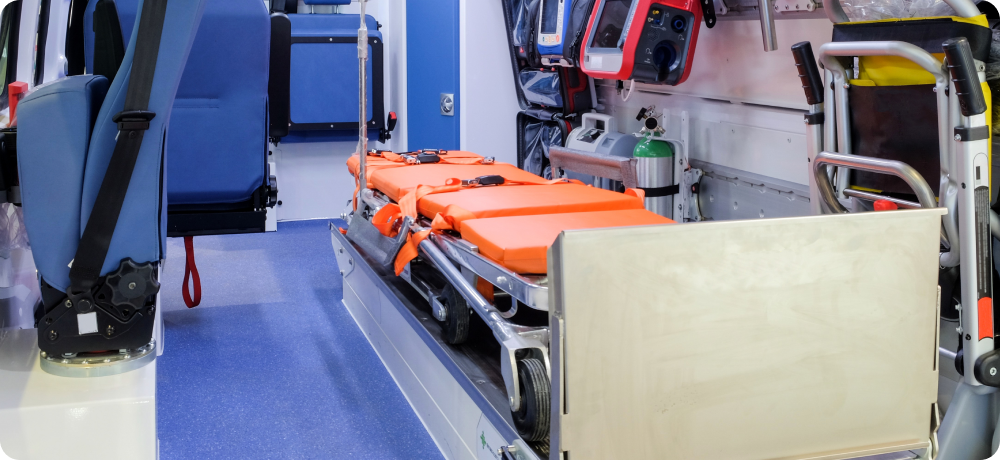
In any emergency, the Athens Medical Center ambulance comes to you immediately. We are by your side 24/7!
Call