

Toys that will help your child’s development at 1-2 years old
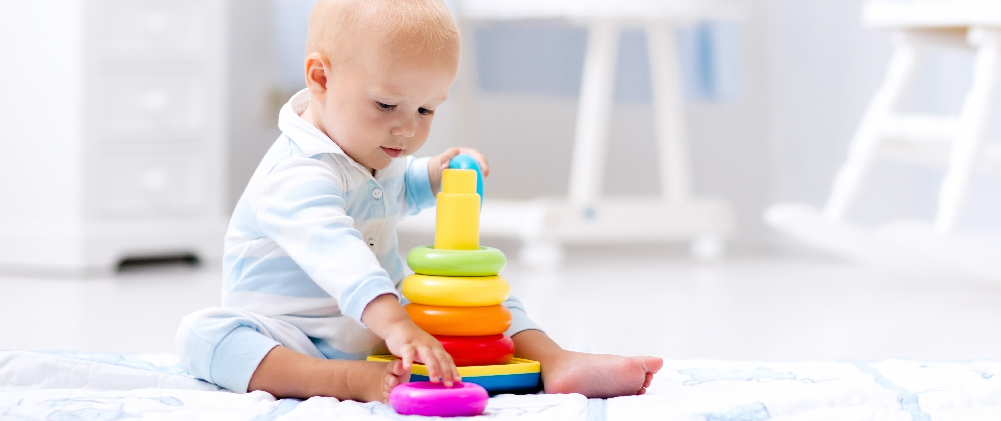
Play is a unique element of the nature of a child of any age.
It contributes significantly to the physical, psycho-emotional, social and cognitive development of the child.
At any age, the child needs “play”, even from birth.
At the age of 1-2 years, the toddler:
- Participates more actively in interactive games. For example, he notices, for example, from the age of 12 months, that by throwing a toy from the highchair, the caregiver will pick it up and return it to him. So, he repeats this “game” over and over again.
- Participates in social interaction games such as “cuckoo-cha” and “glue it”.
- Finds exploring objects fun. Through play, he slowly understands the cause-effect relationship and attempts to solve small problems using the trial-and-error method, such as discovering which button he needs to press on a musical toy to make it work.
- He learns the role of everyday objects (e.g. spoon, cup, comb) and begins to use them in his play (symbolic play).
- He moves freely in space and thus his tendency to explore the shape, size and movement of objects and people in space increases.
Suitable toys for children aged 1-2 years:
- Multi-activity toys.
- Musical toys.
- Toys that the child can lean on and push when he can stand, so that he can gain balance and confidence in an upright position.
- Soft balls, vehicles, fabric cubes when crawling, so that he has motivation to exercise his body.
- Cubes or boxes in various sizes or rings with a rod, so that he can take them out and put them in and gain a correct perception of space.
- Kitchenware and objects like those we use every day, e.g. a children’s toothbrush, as at this age he learns the use and function of common objects.
- Books that the caregiver can read to him with the aim of enhancing the child’s language development.
- Toys with wheels that the child can “drive” by pushing with his feet. They help him gain control of balance, movement and speed.
- Shovels, buckets, rakes, which help him gain a sense of materials, texture and colors.
- Constructions, cubes, puzzles with a few pieces, which facilitate spatial perception and visual-motor coordination.
- Objects that promote symbolic play: toy phones, pots, dishes, cars, dolls, animals, strollers, etc.
- Sand or water games.
- Picture books, short stories and songs.
Tips regarding toy safety:
- Take into account the recommended age of use of toys by the manufacturer as this is suggested based on the safety of the toy, and the child’s ability to play with the toy and understand how it is used.
- For children under 3 years of age, choose large toys to avoid the risk of swallowing and choking. Toys with a diameter greater than 3 cm and a length greater than 6 cm are considered safe.
- Avoid round-shaped toys (marbles, coins, small balls).
- Remove accessories such as ropes, ribbons or beads from stuffed toys.
- If you use toys with batteries, make sure they are placed in a screw-on case to prevent the child from accessing the batteries. Battery fluids are poisonous, while small batteries can cause aspiration.
- Prefer fairly hard toys that do not break easily, do not have small parts that can be cut off (eyes, wheels, buttons).
- Frequently observe toys for loose or broken parts and check second-hand toys for their safety.
- Do not use balloons or latex gloves for play with children under 8 years of age due to the risk of aspiration.
Author