

Types of cancers preventable with the HPV vaccine
A long way has been traveled since the time of the preparation of the first vaccines.
The perpetual goal is the prevention of infectious diseases that decimate populations in the form of epidemics that often take on a pandemic character.
However, the rapid advances in molecular genetics and biology have led to the preparation of vaccines based on the deciphering of the genome of viruses and bacteria, the identification of structural and at the same time immunogenic proteins.
Recently, it has become possible to transfer a segment of mRNA that contains the genetic information for the indigenous synthesis by the host of an immunoactive protein capable of stimulating the immune system to produce neutralizing antibodies.
In the dark field of carcinogenesis, families of potentially oncogenic viruses have been implicated in the etiology.
Among these, the following are of primary importance:
- retroviruses
- human papillomaviruses (HPV)
- hepatitis B and C viruses.
Thus, a new chapter in vaccinology was opened, that of prevention, through vaccination, not of infections, but of malignant neoplasms.
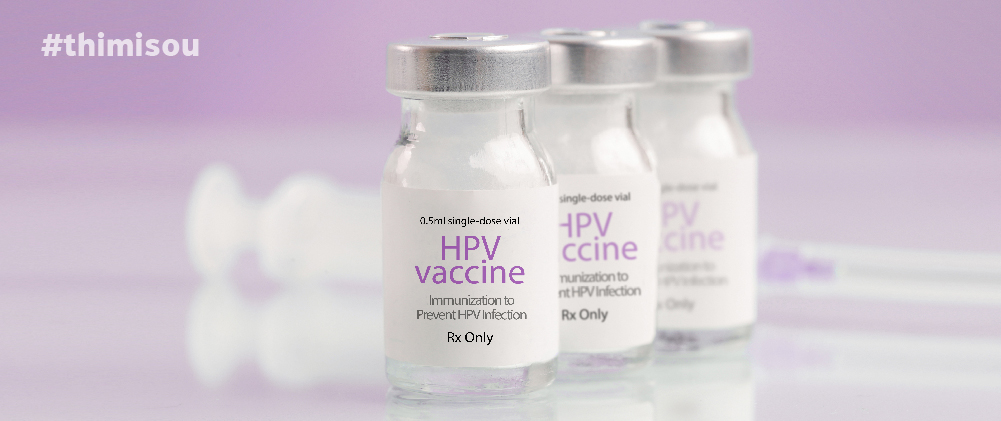
The subject of this article is HPV viruses, the types of cancers they cause, and the vaccine that is currently available for protection, ideally before our exposure to the oncogenic effect of these viruses.
HPV (Human Papilloma Virus) are DNA viruses, belonging to the Papillomaviridae family with over 170 identified types, with over 40 types transmitted through sexual contact, infecting the anogenital area.
It should be noted that HPV infection is the most common sexually transmitted disease.
Risk factors in these cases are:
- young age of first contact
- changing sexual partners
- response of our immune system.
In the majority of cases (90%) the infection they cause is asymptomatic and resolves within two years.
However, in some cases, the infection becomes chronic and results in:
- papillomas and
- precancerous lesions
in exposed tissues such as:
the cervix, vagina, vulva, penis, anus, mouth, tonsils and trachea.
Virtually all cases of cervical cancer are due to HPV viruses.
Two of the strains (HPV16 and HPV18) are responsible for 70% of cases. In particular, the HPV16 strain is responsible for 90% of HPV cancers of the oropharynx. It is important to emphasize that 60-90% of the cancer cases mentioned above are related to HPV viruses. In fact, HPV6 and HPV11 subtypes lead to the development of papillomas in the genital area and the larynx
HPV viruses only infect humans and can be transmitted from mother to fetus during pregnancy.
It has been found that patients with active infection of the anogenital area harbor HPV viruses on their fingers.
In addition, HPV viruses are not destroyed by antiseptic solutions and hand cleaners.
The fact that HPV infection is the most common sexually transmitted disease and that it is not without consequences as it is associated with the development of various types and locations of cancers, has made prevention imperative. In fact, prevention in the form of a tire vaccine because mechanical prevention through the use of condoms is unsafe.
There are 3 vaccines in use:
- Quadrivalent vaccine containing types 6,11,16,18 (HPV 4). (Released in 2006)In 2016, the tetravalent vaccine was replaced by
- Bivalent vaccine containing subtypes 16,18 (HPV2). (Received marketing authorization in 2009) and
- Ninevalent vaccine containing types 31,33,45,52 and 58 (HPV9). (Where it replaced the tetravalent in 2016)
The HPV9 vaccine is practically available and administered on the market.
The aforementioned vaccines do not contain the HPV virus genome but the structural protein L1 which is produced biosynthetically using recombinant DNA technology in yeast.
It is understood that because HPV vaccines do not contain the DNA genetic material of the virus they cannot cause disease.
In general, the vaccine is administered to age groups from 9 years old up to their 15th birthday in 2 doses with an interval of 6-12 months and with a shorter distance of 5 months from the 1st dose (scheme 0.6-12).
For the age groups 16-26 years, the vaccine is administered in 3 doses according to the scheme 0.1-2.6 months and with a shorter distance of one month from the 1st to the 2nd dose, 5 months from the 1st to the 3rd dose and 3 months from the 2nd dose from the 3rd dose. It is worth noting that if the vaccination regimen is interrupted, the entire regimen is not repeated but is completed with the missing doses as normal. Also, vaccination that began with a bivalent vaccine or a quadrivalent can be completed with a nonavalent.
Furthermore, vaccination that has already been completed with a bivalent or quadrivalent vaccine does not need to be completed with a nonavalent.
It is emphasized that the effectiveness of the vaccine is 97% and despite vaccination, the annual colposcopy and Pap test will continue to be included in the preventive check-up and be performed normally starting from the age of 21 until the age of 65.
The age at which HPV vaccination is scheduled coincides with the age of vaccination with the Men ACYW135 and Tdap vaccine. It is emphasized that any combination is permissible, not only between the vaccines but also with any other vaccine if the recommended regimen has not been completed.
Like other vaccines, HPV has no therapeutic effect and immunologically covers only the serotypes to which the individual has not already been exposed. For this reason, the vaccine is recommended at the beginning of adolescence at an age when most people have not begun sexual activity.
It should be noted that vaccination is interrupted in the event of an incidental pregnancy and continues after childbirth due to a lack of relevant epidemiological data.
It should be noted that vaccination is not related to breastfeeding.
Regarding conditions of primary or secondary immunosuppression, it should be emphasized that the 3-dose vaccination regimen is not modified, but the immune response may be impaired.
Adverse reactions during and after vaccination include local (redness, swelling, pain) at the injection site and general (headache, fever, malaise) but of short duration.
As with any vaccination, the painful procedure is responsible for the fact that some adolescents may experience a syncopal (vagotonic) episode; for this reason, it is recommended that vaccination be performed in a sitting or horizontal position and that the vaccinated person remain in the clinic for 15 minutes.
It is emphasized that HPV vaccines have excellent immunogenicity and efficacy, excellent tolerance, long-term maintenance of geometric mean antibody titer, and absolute safety. They do not cause ovarian failure or infertility.
Recently, in many Western countries, it has been proposed and already vaccinated with HPV vaccine for boys of the same age as girls and with the same vaccination schedule.
The rationale for vaccinating males is not only to increase protection for girls, a parameter that is overlooked in a community with high vaccination coverage (>80%) of girls, but also because the virus is equally transmitted to boys, causing warts and malignancies of the anogenital area.
Of course, due to the high cost of the HPV vaccine, it will also increase the corresponding budget, but in the long run, it is better and more economical to prevent than to cure.
Author