

The burden and role of the caregiver in people suffering from dementia
The ageing of the population has led to an increased incidence of Degenerative Diseases.
Dementia is a degenerative disorder of the brain, with Alzheimer’s Disease being its most common form.
Alzheimer’s disease (AD) is a chronic neurodegenerative disorder characterized by impaired cognitive function and leading to deterioration in a number of functions such as memory, speech, judgment, decision-making, orientation and knowledge.
AD accounts for nearly two-thirds of all cases of dementia in the elderly and leads to significant changes in a person’s daily life, living conditions and activities.
The total prevalence of AD is currently estimated at approximately 24 million and is projected to more than double every 20 years until 2040 (Reitz C. et al. Nat Rev Neurol 2011), (Ferri C P et al. Lancet 2005).
AD is one of the most important healthcare, social and economic challenges of the 20th century. In the United Kingdom, 820,000 people have dementia and two-thirds of them are cared for informally at home by a friend or relative (Luengo-Fernandez R et al. Dementia 2016).
The contribution of informal caregivers in AD is significant. In the USA, in 2010, approximately 15 million family members and other volunteer caregivers provided around 17 billion hours of care to people with AD and other forms of dementia.
This contribution was valued at more than 202 billion US dollars (USD) (Alzheimer Association 2011).
Caregivers constitute a key element in the care of patients with AD and their contribution should not be underestimated.
Caregiver burden, as defined by George LK et al. (1986) and still accepted today, is described as a specific complex and multidimensional condition that has physical, psychological or emotional, social and financial consequences for caregivers who are family members of patients with dementia.
Although the positive aspects of informal care for these patients have been demonstrated, it has also been confirmed that caregiving is associated with poor quality of life and deterioration in the health of many caregivers, particularly when care is long-term and demanding.
For this reason, researchers have sought both to identify the factors contributing to caregiver burden and to explore ways of reducing that burden.
Therefore, although caring for patients with AD has certain positive aspects, the simultaneous negative effects on the caregiver’s physical, social, emotional and financial status may be devastating (Vellone E et al. Adv. Nurs 2008). In addition, some of these negative effects may persist for up to 12 months after caregiving ends.
NEGATIVE OUTCOMES OF CARING FOR PATIENTS WITH ALZHEIMER’S DISEASE
Caregiving is associated with a broad range of psychological and physical symptoms, as shown in Table 1:
| SOCIAL | PSYCHOLOGICAL | FINANCIAL | PHYSICAL |
| 1) ISOLATION | 1) DEPRESSION | 1) UNEMPLOYMENT | 1) FATIGUE |
| 2) LONELINESS | 2) ANXIETY | 2) COST OF SPECIAL EQUIPMENT | 2) PAIN |
| 3) GUILT | 3) CARDIOVASCULAR DISEASE | ||
| 4) METABOLIC DISEASE |
Lack of knowledge and incorrect understanding regarding the course of AD, as well as beliefs about the moral obligation of family members to provide care to the patient, may lead relatives to be unwilling or unable to seek help with caregiving.
In this way, caregivers may enter a downward spiral of isolation, loneliness and depression.
The following findings have been identified in studies of caregivers of elderly populations, including people with AD.
Disruption of daily routine, health problems, financial pressure and lack of family support, resulting in depression and anxiety.
In addition, there is an association between depression and poorer physical health among caregivers, including interrupted sleep, increased frequency of cardiovascular and metabolic diseases, reduced immunity and Chronic Fatigue Syndrome.
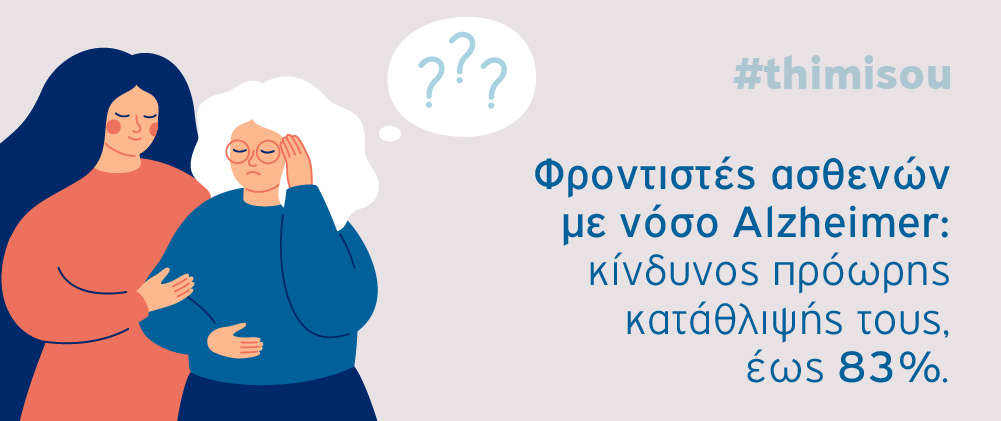
The risk of early depression among these caregivers may be as high as 83%.
POSITIVE OUTCOMES OF CARING FOR PATIENTS WITH ALZHEIMER’S DISEASE
Positive outcomes of caregiving include companionship, a sense of reward and enjoyment.
Factors associated with positive outcomes in caring for patients with AD include a previously good relationship with the patient, older age, good health, maintaining free time, fewer emotional outbursts, caregivers remaining with the patient by choice, and satisfaction with social support.
The factors determining caregiver burden in patients with AD concern both the caregiver and the patient, and the characteristics influencing this burden are illustrated in Table 2.
CAREGIVER AND PATIENT CHARACTERISTICS THAT AFFECT CAREGIVER BURDEN IN PATIENTS WITH ALZHEIMER’S DISEASE
CAREGIVER CHARACTERISTICS
- Age
- Duration of caregiving
- Workload
- Gender
- Educational level
- Income
- Employment status
- Sleep disturbance
- Coping style
- Understanding of the disease
- Psychological status
- Relationship with the patient
PATIENT CHARACTERISTICS
- Duration of disease
- Disease severity
- Presence of psychiatric symptoms
- Severity of cognitive impairment
- Functional abilities
- Poor quality of life
- Educational level
The demographic and psychosocial characteristics of caregivers that predispose to greater burden include advanced age, low socioeconomic status, family relationships, coping style and low social acceptance.
The effect of caregiver gender on burden is particularly interesting.
A number of studies indicate that male caregivers are more prone to physical conditions, particularly cardiovascular disease, while women are more prone to psychological problems.
Coping style is an important predictor of caregiver burden.
Caregivers who use optimistic thinking and stoicism as coping strategies show a more favorable course in terms of caregiving burden than those who constantly perceive problems in their caregiving role and seek support and solutions from others.
The most successful approach to managing the care of a patient with AD is one that is emotion-based and focused on the specific problem at hand.
In addition, caregivers who feel that they have greater control over their role and who accept life’s challenges appear to suffer less from depression than their counterparts.
Adult children of patients with AD appear to experience fewer negative effects as caregivers than spouses who act as caregivers.
Being related to the patient is an important factor in caregiving.
PATIENT CHARACTERISTICS THAT AFFECT CAREGIVER BURDEN
The main patient characteristics that affect caregiver burden are the degree of behavioral disturbance and cognitive impairment.
Other relevant factors include the presence of irritability and psychotic symptoms, the duration of dementia, the patient’s educational level and the presence of depression.
Finally, the patient’s attitude toward treatment and refusal to receive treatment increase the caregiver’s burden.
SUPPORT INTERVENTIONS FOR CAREGIVERS OF PATIENTS WITH ALZHEIMER’S DISEASE
Support interventions for caregivers are divided into:
- Face-to-face interventions
Caregivers are trained individually in coping strategies rather than in groups. This is more successful when combined with psychosocial education.
Training includes various topics such as information about the disease, organization of care, practical guidance on managing the disease, skills for dealing with behavioral problems, guidance on the emotional impact of being a caregiver and self-care recommendations.
- Telephone support programs
These programs are more economical for supporting caregivers, particularly spouses of patients with behavioral disturbances.
Telephone support is highly beneficial and may offer more advantages than conventional group care.
In addition, spouses with low self-esteem and high levels of anxiety at the beginning of the disease benefit greatly from this type of support, particularly at older ages.
- Computer-based support programs
With this system, no significant positive outcomes were observed among caregivers.



